
Changelog

Follow new updates and improvements to contentmaker.

Dropbox and Google Drive integrations are here!

Making a folder for every new project, naming it, filing it under the right client and pasting the link into the project: it's the same five minutes every time, and it's easy to forget. Now you don't have to. Connect your workspace's Dropbox or Google Drive once, and every new project gets its own folder, made and linked the moment the project is.

Connect once, and every new project gets a folder

Open Settings → Integrations and find the new Cloud storage card. Click Connect Dropbox or Connect Google Drive, sign in, and you're done. From then on, every new project gets a folder like this, linked from the Cloud link button in the project header:

  • Contentmaker
    • Atlas Brewing, one folder per client
      • 2026.10.05 - Spring Launch, starting with the day the project was created
        • 01 Footage · 02 Audio · 03 Graphics · 04 Project files · 05 Exports

It doesn't matter where the project is created: the dashboard, the assistant, a recurring project. It gets its folder.

Rename a project, and its folder follows

Change a project's name and its folder is renamed to match. The date at the start stays put, so a client's folders stay in the order they started.

Set it up your way

Everything works without touching a setting, but it's all yours to change on the same card:

  • Where project folders go: pick any folder in your Dropbox, or any folder in Google Drive, including a Shared Drive.
  • Folder layout: a folder per client with the projects inside, or all projects side by side.
  • The date at the start of each folder name, on or off.
  • Folders inside every project: type your own list, one per line, or leave it empty.
  • Give every new project a folder: switch it off if you'd rather make folders yourself.

A preview line on the card shows exactly what the next project's folder will be called.

Works with the account you already have

A personal Dropbox, a Dropbox team, a personal Google account or Google Workspace: they all work. With Google Drive, Contentmaker only ever sees the folders it makes and the folder you choose, nothing else in your Drive.

Already have projects without a folder? Open the project's Cloud link button and choose Create project folder.

Working with Contentmaker's editing service? Nothing changes for projects you share with us. They keep their folder in our Dropbox, where our editors work. The projects you keep to yourself can now go into your own storage.

The full guide, with every setting explained, is in the help center: Connect Dropbox or Google Drive for automatic project folders.


Want the day-by-day? Every release lands inside the app under What's new. Open the ? help menu at the bottom of the sidebar. This changelog collects the highlights; that page has the lot.

Got an idea, or found something broken? Give feedback, in the same menu, opens the feedback board. Post a feature request or a bug report, and upvote what other people have asked for. The most-wanted requests are what we pick up next, and you can follow the whole Roadmap from there too.
New

Refer a company, earn credit

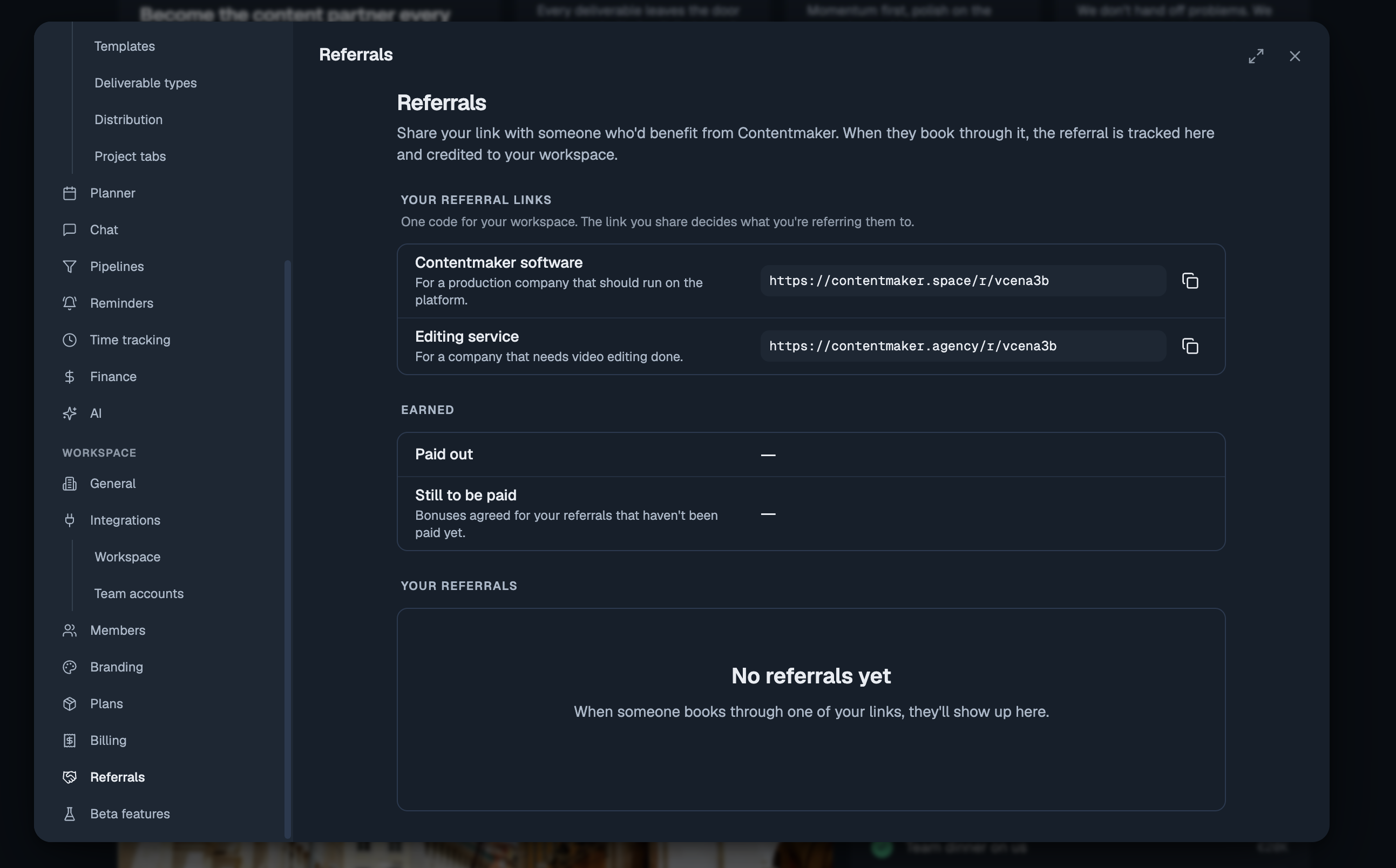
Know a production company that should be running on Contentmaker, or a brand that needs video editing done? Every workspace now has its own referral links, and a referral that becomes a customer earns you credit.

What you get

When someone you referred becomes a customer:

  • Contentmaker software: you get €80 credit on your next invoice for every seat they buy. Refer a team that buys 10 seats for a year and you get €800 off.

  • Editing service: you both get €250 in editing credits: €250 for you and €250 for the client you referred.

Where to find your links

Open Settings → Referrals. You have one code with two links, one for each thing you can refer someone to. The link you share decides which programme the referral counts for. Copy it and send it on.

Follow what happens

The same page lists everyone you've referred, with the programme, the date and where it stands: in progress, became a customer or didn't go ahead. Next to that are your bonuses, paid out and still to come.


Want the day-by-day? Every release lands inside the app under What's new. Open the ? help menu at the bottom of the sidebar. This changelog collects the highlights; that page has the lot.

Got an idea, or found something broken? Give feedback, in the same menu, opens the feedback board. Post a feature request or a bug report, and upvote what other people have asked for. The most-wanted requests are what we pick up next, and you can follow the whole Roadmap from there too.

New

Chat is now part of the app

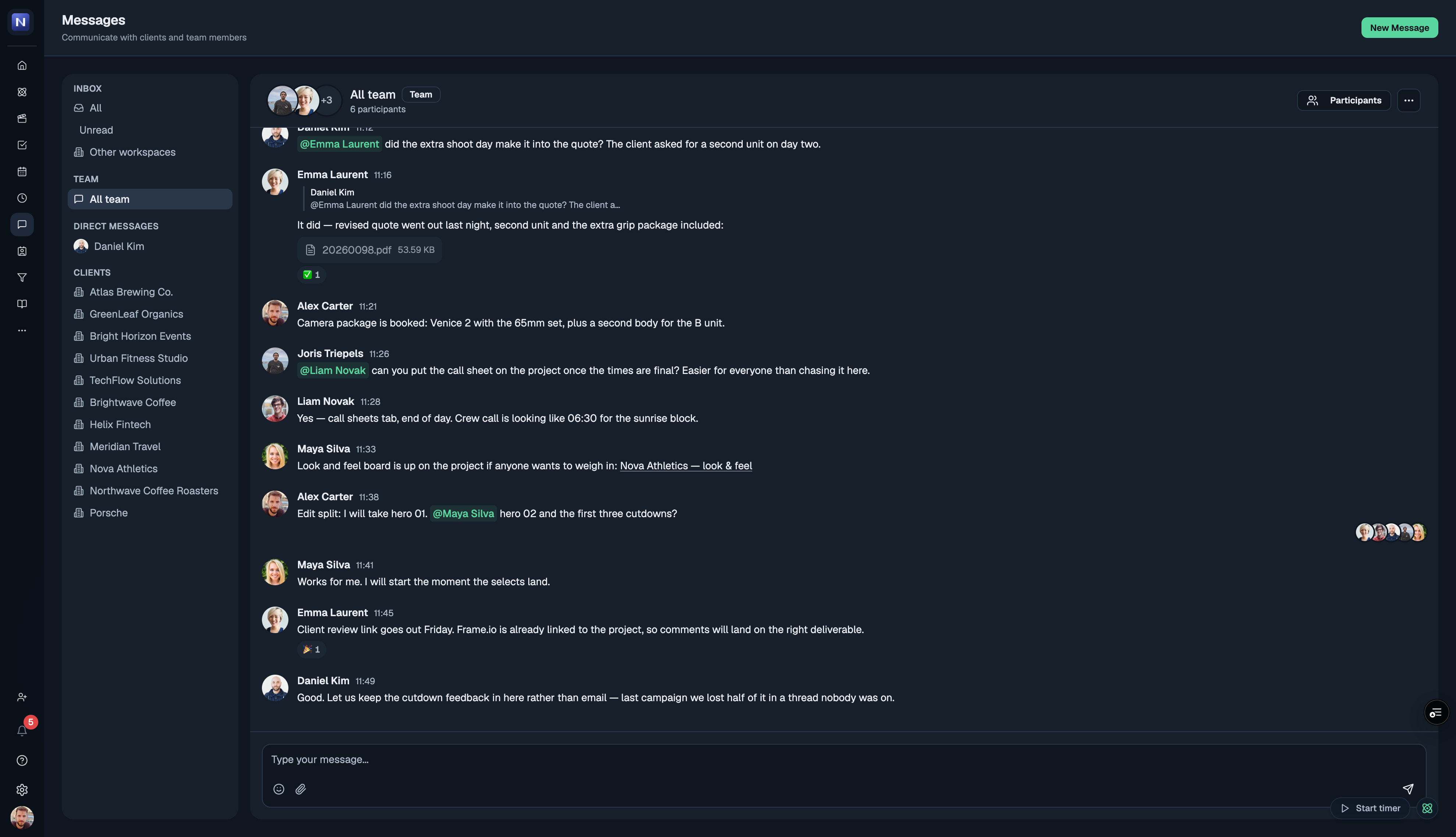
Chat is out of beta. Messages is on for every workspace now — no switch to find, nothing to enable. The reason we built it is simple: the conversation about a project almost never lives where the project does. It is in a WhatsApp thread, someone's inbox, a Google Chat room named after a client from two years ago. Then a shoot moves, and the one person who needed to know was in the other thread. Chat puts the conversation next to the work it is about, so the context comes with it.

Every project brings its own channel

Create a project and its channel comes with it. Your clients each get a place in Messages, with their projects' channels underneath — so the conversation about a film sits with that film instead of in one endless thread per client. Every project also has a Chat tab beside its deliverables, opening the same conversation from the other direction. When a project is finished the channel moves to Archived, so the list stays as short as the work you actually have on.

Your team, and the people outside it

Direct messages for one-to-one, channels for a named group of people. If you work with someone in another workspace on the platform — a client, a freelancer, an editing partner — they appear under External DMs, kept visibly separate from your own team so you always know who is in the room.

It keeps up with you

  • Unread counts on the sidebar and in the browser tab title, so you can tell from another tab that something arrived

  • Optional desktop notifications — off until you turn them on, in Settings → My account → Chat alerts

  • Mute any conversation that does not need you

  • Search across every message you can see

  • Reply to a specific message by quoting it, so a busy thread stays followable

  • See who has read what

  • Drag images straight into a message

Where to find it

The speech-bubble icon in the left rail, or the Chat tab inside any project.

What we want to build next: your clients in the conversation

Right now Chat reaches your team and anyone you work with who is on the platform themselves. A client who only has a share link cannot answer you yet — and that is the piece we want next: a portal your client signs into, an email when you send them something, and their reply landing back in the thread on the project it belongs to. No more forwarding feedback from an inbox into the place the work lives.

Tell us what you think

It is early for this one and we want to know how it holds up against whatever you are using today — what is missing, what would have to be true for your team to move a real conversation into it. Message us or post on the feedback board.


Thanks, Joris

New

Earlier updates